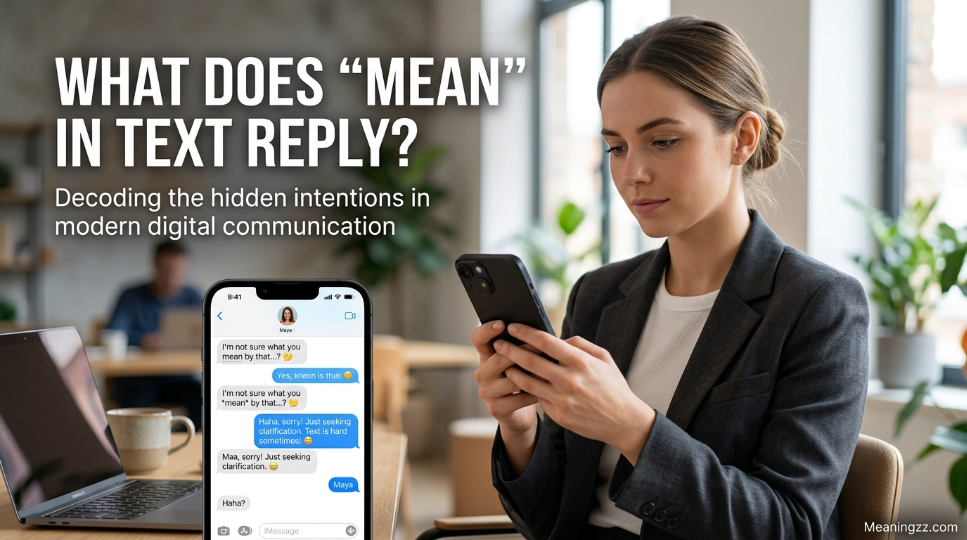
Seeing a short word or phrase in a message and wondering what it means can be confusing, especially when people use texting slang differently across Snapchat, TikTok, WhatsApp, and Instagram. If you searched what does mean in text reply, you’re probably trying to understand a message without overthinking it.
The good news is that most internet abbreviations and casual chat terms are easier to understand once you look at the surrounding conversation. A word can have a literal dictionary definition, a slang meaning, or simply be part of a casual texting phrase. Context, punctuation, emojis, and the relationship between the people chatting can all change the intended meaning.
This guide explains how to interpret “mean” in text replies, how it can appear in online messaging, and how to avoid common misunderstandings.
What Does “Mean” Mean in a Text Reply?
The word “mean” normally refers to what someone intends to say, communicate, or express.
For example:
- “What do you mean?” = “What are you trying to say?”
- “What does that mean?” = “Can you explain that?”
- “I didn’t mean that.” = “That wasn’t what I intended.”
- “What do you mean by that?” = “What exactly are you suggesting?”
In everyday texting, mean usually keeps its normal English meaning rather than becoming a special social media acronym.
However, the exact interpretation depends heavily on the sentence.
For example:
“What do you mean 😂”
may sound playful or curious, while:
“What do you mean?”
could sound more serious.
Similarly:
“I didn’t mean it.”
often indicates that the person wants to clarify that something they said wasn’t intentional.
So, unlike many texting abbreviations, mean generally isn’t a Gen Z abbreviation with one fixed secret definition. It is usually ordinary English used in a casual chat.
Different Meanings of “Mean” in Online Messaging
One reason people get confused by the word is that mean can have several meanings in English.
1. To intend something
This is extremely common in text conversations.
Example:
“I didn’t mean to ignore you.”
Here, “mean” means intend.
2. To ask about someone’s message
Someone may write:
“What do you mean?”
They are asking for clarification.
This can be friendly, confused, surprised, or annoyed depending on the context.
3. To refer to something’s definition
For example:
“What does this word mean?”
Here, “mean” refers to the definition or explanation of something.
4. To describe unkind behavior
“Mean” can also mean unkind or unpleasant.
Example:
“Why are you being mean?”
This isn’t asking for a definition. The sender is saying that someone’s behavior feels unkind.
5. Mathematical meaning
In mathematics, “mean” can refer to the average of a set of numbers.
For instance, the arithmetic mean of 4, 6, and 8 is 6.
This meaning is uncommon in casual chat unless the conversation is about school, statistics, or mathematics.
How “Mean” Appears on Snapchat, TikTok, WhatsApp, and Instagram
Different platforms have their own texting culture. However, the word “mean” generally doesn’t change its basic definition just because you’re using a particular app.
Snapchat Slang
On Snapchat, conversations are often extremely short and informal. Someone might type:
“What u mean?”
This is simply a shortened casual version of:
“What do you mean?”
The use of “u” instead of “you” is texting shorthand rather than a separate definition of “mean.”
TikTok Meaning
TikTok comments frequently contain internet abbreviations, memes, and Gen Z slang. If someone comments:
“What does this mean?”
they are normally asking for an explanation.
The surrounding TikTok trend or meme may determine what they’re asking about.
WhatsApp Meaning
WhatsApp conversations can range from formal messages to extremely casual chats.
You might see:
“Bro what do u mean 😭”
The meaning is still essentially:
“Bro, what are you trying to say?”
The emoji can make the message feel humorous rather than confrontational.
Instagram Chat Terms
Instagram DMs commonly use abbreviations such as “wyd,” “idk,” “rn,” and “lol.” However, when someone writes “mean,” it usually functions as a normal English word.
For example:
“Wait, what do you mean?”
is asking for clarification.
Texting Examples Using “Mean”
The easiest way to understand chat meaning is to see the word in realistic conversations.
Example 1: Asking for clarification
Person A: “You should probably stop.”
Person B: “What do you mean?”
Here, Person B wants more information.
Example 2: Explaining intention
Person A: “That sounded rude.”
Person B: “Sorry, I didn’t mean it that way.”
Here, “mean” refers to intention.
Example 3: Friendly confusion
Person A: “You already know what happened.”
Person B: “What do you mean 😂?”
The emoji suggests that the question may be playful.
Example 4: Serious conversation
Person A: “I don’t think we should talk anymore.”
Person B: “What do you mean?”
Here, the same phrase can feel much more serious because of the surrounding conversation.
Example 5: Asking about a word
Person A: “I keep seeing ‘IMO’ online.”
Person B: “What does it mean?”
Here, “mean” refers to the definition of an internet abbreviation.
Example 6: Accidental statement
Person A: “You never help me.”
Person B: “I didn’t mean to say that.”
In this situation, “mean” describes intention.
When Should You Use “Mean” in Texting?
You can use “mean” naturally whenever you want to discuss intention, explanation, or definition.
Common situations include:
- Asking someone to explain a message
- Clarifying what someone intended
- Explaining that your words were misunderstood
- Asking for the definition of an unfamiliar term
- Talking about someone’s behavior
- Discussing the meaning of a meme or phrase
Some common casual texting phrases include:
- “What do you mean?”
- “Wdym?” — What do you mean?
- “What does that mean?”
- “I didn’t mean that.”
- “That’s not what I meant.”
- “What did you mean by that?”
- “Do you mean this?”
- “I know what you mean.”
Notice that WDYM is the actual social media acronym in several of these examples. “Mean” itself is not necessarily an abbreviation.
When Should You Avoid Using “Mean”?
There isn’t anything inherently wrong with using the word “mean.” However, the way you phrase it can affect how your message sounds.
For example:
“What do you mean?”
can sometimes sound confrontational when sent without context.
If you want to sound more friendly, try:
“What do you mean? Just curious 🙂”
or:
“Wait, what do you mean by that?”
For professional or school conversations, avoid overly shortened forms such as:
“wdym?”
unless you already know that casual language is appropriate.
Instead, write:
“Could you clarify what you mean?”
The important difference is tone, not the word itself.
“Mean” vs. “Wdym” and Other Alternatives
If you’re learning texting slang, it’s useful to distinguish between the regular word “mean” and actual internet abbreviations.
WDYM
WDYM means “What do you mean?”
It is common in texting and social media conversations.
Example:
“WDYM you already left?”
What Do You Mean?
This is the complete version and works in almost any casual conversation.
Example:
“What do you mean by that?”
What Are You Saying?
This can be used when you’re confused about someone’s statement.
Example:
“Wait, what are you saying?”
Can You Explain?
This sounds clearer and often more polite.
Example:
“Can you explain what you mean?”
I Don’t Understand
Use this when you genuinely don’t understand the message.
Example:
“Sorry, I don’t understand what you mean.”
What Do You Mean by That?
This is useful when you want clarification about a specific statement.
However, depending on tone, it can sound defensive or suspicious.
Common Misunderstandings About “Mean” in Texts
Because online conversations are short, people can easily misinterpret the word.
Misunderstanding 1: Thinking “mean” is always slang
It isn’t.
“Mean” is a normal English word that appears frequently in texting.
Misunderstanding 2: Assuming one meaning fits every conversation
Context matters.
“What do you mean?” and “You’re being mean” contain the same word but have completely different meanings.
Misunderstanding 3: Ignoring emojis
Compare:
“What do you mean?”
with:
“What do you mean 😂😭”
The second message may feel much more playful.
Misunderstanding 4: Confusing “mean” with “wdym”
WDYM is an internet abbreviation for “What do you mean?” The word “mean” itself is not automatically slang.
Misunderstanding 5: Assuming punctuation always shows anger
A question mark doesn’t necessarily mean someone is angry.
The relationship between the people, previous messages, and overall tone are usually more important.
Misunderstanding 6: Forgetting regional texting styles
People from different countries and age groups may use different casual texting phrases. A phrase that’s common among one group may be unfamiliar to another.
How to Reply When Someone Says “What Do You Mean?”
If someone sends “What do you mean?”, don’t panic. They’re usually asking you to clarify your previous message.
You can respond directly:
“I mean that we should talk about it later.”
Or explain the specific part:
“I meant that I wasn’t upset with you.”
For a casual conversation:
“Lol, I just meant that the situation was funny.”
If your previous message was unclear:
“Sorry, I worded that badly. I meant…”
A clear explanation is usually better than responding with another vague message.
Quick Reply Ideas
Depending on the situation, you could say:
- “I mean exactly what I said.”
- “I meant that we should wait.”
- “Sorry, I wasn’t clear.”
- “I meant it as a joke.”
- “I was just asking.”
- “I meant the first part of my message.”
- “Let me explain.”
These responses help keep online messaging clear and prevent unnecessary misunderstandings.
FAQs
Is “mean” a texting abbreviation?
No. Mean is generally a regular English word. Some abbreviations, such as WDYM, are based on the phrase “what do you mean.”
What does “what do you mean?” mean in texting?
It usually means “Can you explain what you’re saying or what you intended?”
What does “I didn’t mean it” mean?
It generally means “I didn’t intend to say or do that” or “That wasn’t my intention.”
Is “wdym” the same as “what do you mean?”
Yes. WDYM is a common internet abbreviation for “What do you mean?”
Does “mean” have a different Snapchat meaning?
Usually, no. Snapchat users may shorten phrases around it, but the normal meaning of “mean” generally stays the same.
What does “you mean?” mean in a chat?
It can be an abbreviated way of asking someone to clarify their previous statement. The exact tone depends on the conversation.
Can “what do you mean?” sound rude?
Yes, sometimes. A short message without context can sound challenging or defensive. Adding context or a friendly phrase can make it softer.
Is “mean” Gen Z slang?
Not by itself. Gen Z commonly uses abbreviations and casual expressions involving the word, but “mean” is a standard English word.
What is the difference between “mean” and “meaning”?
“Mean” is often used as a verb, such as “What do you mean?” Meaning is the noun describing what something represents or expresses.
How can I understand unfamiliar texting slang?
Look at the full sentence, surrounding messages, emojis, and platform context. If you’re still unsure, simply ask the sender what they mean.
Final Thoughts
The word “mean” usually doesn’t have a mysterious hidden definition in texting. Most of the time, it has its ordinary English meaning related to intention, explanation, or definition. The context is what matters most. “What do you mean?” asks for clarification, while “I didn’t mean it” talks about intention, and “You’re being mean” describes unkind behavior.
When you’re dealing with texting slang, internet abbreviations, Snapchat slang, TikTok meaning, social media acronyms, WhatsApp messages, or Instagram chat terms, avoid interpreting a single word in isolation. Look at the complete message and the conversation around it.
Once you understand that principle, unfamiliar online messaging becomes much easier to decode—and you can recognize whether you’re looking at genuine Gen Z slang, a social media acronym, or simply a normal English word being used casually.
